Genesys Cloud - Main

 View Only

Sign Up

Expand all | Collapse all

Bot Bash is BACK!

  Thread closed by the administrator, not accepting new replies.
  • 1.  Bot Bash is BACK!

    Posted 10-01-2026 09:47
    Edited by Nicole Milliken 9 days ago
    No replies, thread closed.

    You've waited an entire year...and it's back from the dead! The third annual Bot Bash is here to showcase YOUR scary inventions with Genesys! 

    This year, we want to hear about something that wasn't working, and how you brought it back to life.

    Every great creation starts with a problem. What was broken and what happened when you flipped the switch using Genesys AI products? 

    TELL US:

    THE GROTESQUE: What needed a few stitches?
    Maybe a flow had become a monster to maintain, agents were buried in manual work, or customers were scary frustrated with a bot.

    THE EXPERIMENT: What did you change?
    Show us how you used Genesys AI products to rethink, rebuild, or improve the problem. We want those detailed items from your laboratory notebook.

    IT'S ALIVE: What happened next?
    Tell us what changed. What works better now? What did you learn? And what would you tell another mad scientist attempting the same experiment?

    Screen shots are encouraged! (Make sure private info is removed).

    We will have a panel of judges read the submissions to choose a winner! You have the whole month of October (October 1st - 31st) to get your entry in. For more information about the Bot Bash, please go to the landing page here (which explains rules, prizes, and has additional info). 

    THE LAB IS OPEN! Let the Bot Bash Begin...


    #CommunityAnnouncements

    ------------------------------
    Nicole
    Senior Online Community Video Specialist
    ------------------------------


  • 2.  RE: Bot Bash is BACK!

    Posted 10-01-2026 10:29
    No replies, thread closed.

    My support team found ourselves buried in a shallow grave of manual work.  Managing users across 14 different orgs surfaced constant screams of "what is my login URL?", shrieks of "It won't accept my password" and midnight howls of "I can't get logged in" that caused us to have to search for where a user was, and issue them their organization name appended login URL for our region (we're not in the one google results point you to, so count that as an issue, too).

    The experiment.  Initially, we built a CLI tool to check the orgs for the user's email address and return the appropriate URL, but this was still a manual process, just less time consuming.  So a teammate had the thought:  what if we rebuilt that into a webservice and made a support bot to field the request.  And that is what we did, with a veritable Frankenstein's monster of AWS services we created a user export ETL job that runs against all of our orgs at a regular cadence to populate a table that a lambda function (thanks integration data actions) points to to retrieve the URL and relevant data for a user via a bot flow.

    We're still in an early deployment phase, but we intend to have it in a voicebot flow as well that will email the user their login URL.  This has the added benefit of giving us a prebuilt demo/explainer flow when our customers ask us for technical showcases.

    I guess I dropped the spooky there for the last parts.  Uhhh, boo.


    ------------------------------
    Aaron Lael
    State of Utah - comments on this forum reflect my own personal opinions\observations and are separate from any entity I am otherwise involved in.
    ------------------------------


  • 3.  RE: Bot Bash is BACK!

    Posted 10-01-2026 11:13
    No replies, thread closed.

    Hah! I love you kept with the theme Aaron! LOL


    ------------------------------
    Nicole
    Senior Online Community Video Specialist
    ------------------------------


  • 4.  RE: Bot Bash is BACK!

    Posted 10-01-2026 10:49
    No replies, thread closed.

    Quality4ME: Bringing Quality Evaluations and Agent Feedback Back to Life

    THE GROTESQUE: Scaling quality while keeping agents involved

    In one customer operation, Genesys AI Scoring was already supporting quality evaluations, but completing the workflow still required repetitive operational work.

    There was also an important business requirement: agents needed to receive their evaluations, review the feedback, and be able to agree with or contest the assessment.

    The native fully automated evaluation workflow we assessed did not support that complete agent participation process for our use case. Adopting it would have left an important part of the operation's quality process unsupported.

    Between April and June 2026, the operation recorded approximately 496 evaluation finalizations per month. We needed to increase that capacity while preserving the feedback and acknowledgment process.

    THE EXPERIMENT: Combining Genesys AI with Quality4ME

    At Solve4ME, we developed Quality4ME, a complementary solution that supports quality evaluation workflows alongside Genesys Cloud.

    We kept the semi-automated evaluation process in Genesys, using AI Scoring to support the assessment, and used Quality4ME to finalize evaluations.

    This approach preserved the operational flow in which agents could receive their evaluations, review the feedback, and agree with or contest the results.

    Our work focused on:

    • Reducing repetitive operational activities.

    • Supporting higher evaluation volumes.

    • Preserving agent participation in the quality process.

    • Improving visibility into completed evaluations and outstanding work.

    We have also submitted enhancement ideas to Genesys requesting support for this agent feedback and acknowledgment/dispute process within the native fully automated experience.

    We measured the initiative through actual application usage, recorded finalization volumes, and a separate review of evaluation distribution across agents.

    IT'S ALIVE: Greater scale with the feedback process preserved

    During July and August 2026, the operation recorded approximately 1,756 finalizations per month, compared with 496 per month in April–June: approximately 3.5 times the monthly volume.

    In August alone, 1,762 of 1,784 finalizations were performed through Quality4ME: 98.8% of the month's total.

    Evaluation demand and policy settings also changed during this period, so these figures describe observed operational volume and adoption.

    The sampling review revealed a further improvement opportunity. Across the queues reviewed in July, evaluation creation reached approximately 62% of the planned volume, while only 28% of active agent-days received at least two evaluations, the daily target used in the analysis.

    That finding reinforced the importance of monitoring distribution across agents alongside overall completion volume.

    Our biggest lesson was to design automation around the complete quality journey, including the person being evaluated. Receiving feedback, understanding an assessment, and having an opportunity to contest it were essential requirements of this operation.


    ------------------------------
    Mateus Nunes
    CX Manager at Solve4me Solucoes em Tecnologia Ltda
    ------------------------------


  • 5.  RE: Bot Bash is BACK!

    Posted 10-02-2026 11:36
    Edited by Fnu Ganesh 10-02-2026 11:36
    No replies, thread closed.
    It's ALIVE! Stitching Our Genesys Voice Bots Back Together
    THE GROTESQUE: What needed a few stitches?
    Our Genesys voice bots were working, but they had grown into a creature nobody wanted to maintain:
    - Mismatched journeys: Authentication happened at different points in related bot flows, so customers had an inconsistent experience.
    - Missed urgent callers: Customers calling about possible fraud didn't always get a fast path to a banker.
    - Messy bot internals: The "ask for intent" and "ask for slot" blocks had become cluttered, which hurt how well the bot understood callers and made debugging harder.
    - Menu friction: Callers often got misclassified, defaulted to asking for an agent, and bankers had to transfer them by hand.
    - Hidden costs: AI token use and TTS charges were growing faster than we expected.

    THE EXPERIMENT: What did we change?
    - Made authentication consistent: We moved the authentication step so it happens at the same point across related bot flows.
    - Added a hidden fraud intent: If a caller mentions possible fraud, the bot routes them straight to a banker.
    - Cleaned up the intent and slot blocks: This improved how well the bot understands what callers say and made debugging easier.
    - Tuned confidence thresholds: Below 40%, the bot doesn't act on the intent. From 40% to 70%, it asks the caller to confirm. Above 70%, it routes straight away.
    - Balanced cost against experience: When a new authentication approach raised AI token use, we moved back to the common authentication module.
    - Modernized the bot voice: We rolled out the Matthew and Pedro neural voices, worked around system prompts we couldn't edit, and cut TTS costs by tightening prompts and using recorded audio.
    - Set rules for Genesys Copilot summaries: We added custom prompt rules so bankers get summaries of no more than two bullets, with no customer information. 
    - Testing the next step with data: We're comparing a DTMF (keypad) menu with an open-ended speech menu for Business Banking. We'll look at time in bot, containment, routing accuracy and token cost.
    IT'S ALIVE: What happened next?
    - Callers now go through the same authentication journey across related flows.
    - Callers who mention fraud reach a banker faster.
    - The bot is easier to debug and understands callers better.
    - AI token and TTS costs are now part of our design decisions.
    Advice for fellow mad scientists:
    1. Keep journeys consistent across flows, because callers notice when they aren't.
    2. Use hidden intents for high-risk topics like fraud.
    3. Clean up your intent and slot blocks regularly. It makes the bot easier to understand and to fix.
    4. Track token and TTS costs. The "smartest" design isn't always the right one.
    5. Measure before you redesign menus.

    The lab never closes!


    ------------------------------
    Thanks!
    Ganesh S
    ------------------------------


  • 6.  RE: Bot Bash is BACK!

    Posted 10-02-2026 12:48
    No replies, thread closed.

    One interesting experience we had was using AI to improve understanding and information collection during automated interactions.


    For some of our customers, we used AI to identify customer intents and also configured AI-powered slots within the bot flows to help collect and interpret information provided during the conversation.


    This allowed us to create more natural interactions while reducing some of the complexity we would have had with a traditional approach based on multiple rules and decisions within the flow.


    The results were very productive. One of our main lessons was that AI works best when combined with clear instructions, context, and well-defined boundaries.


    ------------------------------
    Augusto
    Gerente de Desenvolvimento de Sistemas e Planejamento
    ------------------------------


  • 7.  RE: Bot Bash is BACK!

    Posted 10-04-2026 22:32
    No replies, thread closed.
    Hi everyone!
    Here's my entry for Bot Bash: an AI agent that turns a plain-language description into a published Genesys Architect flow.
     
    🧟 The grotesque: what needed fixing?
    On every project, demo or pre-sales engagement, I was building the same flows in Architect by hand: IVRs, messaging, email, bots and common modules. They used the same DTMF menus, the same business-hours checks and the same data actions with retries, just rebuilt for each customer. It was slow, and many errors only showed up at publish time: a misspelled queue, a prompt that didn't exist in the org, a variable with the wrong type.
     
    So I tried the obvious thing and asked an AI to write the Archy YAML. It looked perfect and didn't publish. The model made up actions, functions and properties that don't exist, or that depend on the org's license.
     
    ⚗️ The experiment: what did I change?
    I set one rule: the AI doesn't write YAML. It writes a small intermediate JSON format, and a compiler (with no AI) turns that into YAML.
     
    The org's own Archy schemas (archy refresh) are the source of truth. If an action isn't in the schema, the agent can't use it.
    Before compiling, the agent looks up every queue, prompt, data action, data table, skill and AVA in the org. If something is missing, I get a missing-prerequisites report instead of a broken flow.
    If my description isn't enough, the agent asks instead of guessing.
    If a publish fails, it tries to fix it twice at most, then stops and shows me the exact Archy error.
    Everything is exposed as MCP tools, so any AI assistant can design flows with the same rules.
    On the Genesys side, I used Agentic Virtual Agents (imported and published through the API), Bot Flows and Digital Bots as bridges, Function Data Actions and Web Messaging for end-to-end testing.
     
    ⚡ It's alive: what happened next?
    100% first-attempt publish rate with no human edits on my regression suite of 11 flow types (voice, in-queue, outbound, SMS, email, workflow, common module, bots, survey).
    A multi-industry demo kit published in a sandbox org: 1 common module, 2 bridge bots, voice, messaging and email flows, and 9 AVAs. 15 out of 15 end-to-end conversations passed.
    One flow serves 9 industries. To change a queue or an AVA, you edit a row in a data table, not the flow.
    Demos that used to take weeks now come together in hours.
    Tips for the next mad scientist:
     
    Don't let the AI write the final file. Let it write something you can validate, and generate the file with deterministic code.
    Track one honest metric (did it publish on the first try?) and roll back anything that makes it worse.
    Test end to end. That's how I found that AVA End Context outputs without a mapping arrive empty (I fixed it with an "echo" Function Data Action), and that the digital bot's input has to be passed to the AVA as Start Context.
    Wishlist for Genesys: reference an AVA by ID or expression in Architect, a lighter archy validate (a full refresh takes over an hour on a big org), and error messages that tools can act on.
    Atención multivertical omnicanal unificada
     
    flujo Comun Multicanal
    Bot Multivertical
    Thanks for checking it out! I hope it helps others build faster and safer with Genesys Cloud.


    ------------------------------
    Sebastian
    Ingeniero de Proyecto
    ------------------------------


  • 8.  RE: Bot Bash is BACK!

    Posted 10-06-2026 06:14
    No replies, thread closed.

    Submission Title: Frankenstein's IVR: Breathing Life into the Telephony Graveyard

    Subtitle: Transforming Brittle Speech-Rec Menus into a Low-Latency, Generative Voice Bot with Intelligent Handoff

    Part 1: The Grotesque - What Needed a Few Stitches?

    (The Broken, Difficult, Frustrating, and Overly Complicated)

    • The Telephony Nightmare: A monolithic Inbound Call Flow with over 60 nested DTMF menus, brittle dual-tone multi-frequency logic, and first-generation Speech Recognition (ASR) that failed whenever callers had accents, background noise, or hesitated.

    • The Caller Experience Bottlenecks:

      • The "Barge-In" Despair: Static voice prompts played uninterrupted while callers repeatedly screamed "Representative!", eventually triggering a timeout or a disconnect.

      • Dead-Air Drops: Complex backend SOAP and REST Data Actions were firing sequentially on the telephony trunk. When CRM lookups exceeded 4 seconds, the SIP session experienced silence, causing over 18% of callers to abandon before ever reaching a queue.

      • Cold Transfers & "Start Over" Agent Handoffs: Callers forced through 4 minutes of automated speech menus arrived at an agent with zero context, forcing them to repeat their name, account number, and reason for calling.

    Part 2: The Experiment - What Did You Change?

    (Rethinking, Rebuilding, and Modernizing with Genesys Cloud Voice AI)

    We eliminated the sprawling menu maze by restructuring the architecture into a Voice Bot Flow (Genesys Cloud Virtual Agent / Native Bot) backed by dynamic session management and low-latency speech synthesis:

    1. Low-Latency Voice Bot Flow with Streaming ASR & Barge-In

    • Replaced static IVR menus with a dynamic Inbound Voice Bot Flow using Genesys native Voice AI and integrated neural Text-to-Speech (TTS).

    • Enabled configurable speech recognition sensitivity, complete phrase detection, and real-time barge-in. Callers can speak naturally or interrupt long explanations to narrow their request immediately.

    • Implemented Dual-Channel Input: If voice transcription encounters low acoustic confidence (e.g., loud road noise), the bot automatically prompts for DTMF input ("You can also punch in your 6-digit pin on your keypad") without restarting the flow.

    2. Asynchronous Data Retrieval & Audio Fillers

    • Solved the "dead-air" problem by decoupling external data lookups:

      • Placed lightweight conversational filler prompts ("Give me just a second while I pull up your account...") while executing Architect Call Data Action blocks asynchronously.

      • Set hard timeout thresholds (under 3.0 seconds) with explicit failure branches to keep the telephony session responsive and human.

    3. Real-Time Telephony Handoff & Screen Pop Orchestration

    • Integrated the Voice Bot with Genesys Agent Copilot / Agent Assist:

      • Extracted entities (CallerName, AccountNumber, IssueCategory, BotConfidenceScore) and wrote them into participant session attributes using Set Participant Data.

      • Packaged the live bot transcription into the interaction context so the destination agent receives a real-time Screen Pop with a pre-summarized voice transcript the instant the call is answered.

    Part 3: It's Alive! - What Happened Next?

    (Outcomes, Lessons Learned, and Voice Architect Logics)

    1. Measurable Business Outcomes

    • Voice Self-Service Containment: Rose from 9% to 37% on routine inquiries (balance checks, appointment reschedules, claim status).

    • Telephony Dead-Air Abandonment: Dropped from 18% to under 1.5%.

    • Escalated Call Handle Time (AHT): Reduced by 54 seconds per call due to automatic agent screen-pop identification and verification (ID&V).

    2. Core Voice Architect Logics & Best Practices

    When designing production-grade voice bots on Genesys Cloud Architect, implement these foundational rules:

    <response-element class="no-md" ng-version="0.0.0-PLACEHOLDER"></response-element>

    [Inbound Voice Call]
             │
             ▼
    [Initial Identity & Verification] ──(Fails 2x)──► [DTMF Keypad Fallback]
             │ (Success)
             ▼
    [Genesys Voice Bot Flow] ◄───(Barge-in Enabled)
        ├── Intent Recognized ──► [Async Data Action + Filler Audio] ──► [Audio Confirmation]
        ├── Knowledge Query   ──► [Knowledge Workbench Deflection]    ──► [Follow-Up Prompt]
        └── Ambiguity / Failure
                 │
                 ▼
        [Set Participant Data] (Save Transcript, Auth Status, Intent)
                 │
                 ▼
        [Transfer to ACD] ──► [Agent Desktop: Screen Pop + Copilot Summary]
    

    <response-element class="no-md" ng-version="0.0.0-PLACEHOLDER"></response-element>

    • The Voice Latency Budget: Keep round-trip latency (ASR transcription + NLU resolution + TTS playback) strictly under 1.8 seconds. Any delay over 2 seconds feels like a broken call to a phone customer. Use optimized data action payloads and avoid chaining multiple synchronous data actions.

    • Smart No-Input / No-Match State Machine:

      • No-Input 1: Short reprompt ("Are you still there? You can say your account number or enter it on your keypad.").

      • No-Input 2: Shift modality (force DTMF collection block).

      • No-Match 2: Route to queue with participant data: TransferReason = "VoiceRecognitionExhausted".

    • Zero Lost Context on ACD Transfer: Never use a blind Transfer to ACD block without running Set Participant Data first. Write the bot's extracted attributes into standard Genesys attributes (context.customerName, context.authenticated, context.intentSummary) so Agent Workspace scripts, routing rules, and Copilot have immediate context.

    Advice for the Community

    "In digital bots, users can tolerate a 3-second delay; in telephony, 3 seconds of silence is a hang-up. Treat audio latency as a critical architecture constraint. Build your voice bots with generous barge-in windows, explicit DTMF fallback safety nets, and seamless participant data handoffs."


    ------------------------------
    Akshat
    CTI Engineer
    ------------------------------


  • 9.  RE: Bot Bash is BACK!

    Posted 10-06-2026 10:27
    Edited by Dale Wylie 10-06-2026 10:27
    No replies, thread closed.

    Raising Holli from the Dead: How I Rebuilt Our IT Service Desk Chatbot from Scraps

    THE GROTESQUE

    Before I hauled her into my lab for a complete overhaul, Holli, our IT Service Desk chatbot, was an utter monster.

    She had been built as a rigid, clumsy decision tree that forced employees down endless dead-end sub-menus. If someone made a minor typo or phrased a request slightly off, Holli would completely freeze, panic, and drop them into an endless loop. Users were constantly exasperated, typing "HUMAN" in all caps just to bypass her.

    I was left dealing with the fallout:

    • The Service Desk was drowned in repetitive tickets for basic tasks like checking ticket statuses or logging simple requests.

    • Maintenance was an absolute nightmare. Modifying a single option meant trawling through dozens of fragile logic branches in Genesys Cloud, always risking breaking something else in the process.

    • Frustrated employees avoided the bot entirely, preferring to flood our phone lines and inbox instead.

    Holli was functionally useless, and fixing her was entirely down to me.

    THE EXPERIMENT

    I decided to scrap the old setup and rebuild Holli from the ground up, focusing on a clean, conversational user experience and deep backend integration.

    While I don't currently use AI for response generation, I designed her whole structure in Genesys Cloud to feel conversational, friendly, and easy to chat with. Instead of forcing users through cold, rigid decision trees, Holli gently guides them through their issues step by step.

    Here is how I engineered the transformation in my laboratory:

    1. ServiceNow Integration & Self-Service

    Using Genesys Data Actions, I connected Holli directly into ServiceNow. I built self-service workflows that allow staff to log new incidents and check the status of existing tickets straight inside the chat window without needing a human agent.

    2. Custom Agent Screen Pop Script

    When a chat does need to reach an agent, context is everything. I designed a visually pleasing, highly structured Screen Pop Script that triggers the moment the chat lands with a Service Desk agent. It immediately presents the agent with vital triage information:

    • The user's current physical location and asset tag.

    • A brief description of the issue.

    • All currently open tickets for that user.

    • The last ticket the user viewed in ServiceNow.

    3. Expanding Knowledge Base

    I linked Holli to an integrated Knowledge Base so she can answer common IT queries instantly. I am continuously expanding and refining this knowledge library, making her more useful with every passing week.

    IT'S ALIVE!

    The moment I threw the switch on the new Holli, the transformation was staggering.

    Holli went from being an annoying obstacle to an essential tool for our whole organisation. Employees actually enjoy using her because the conversational flow feels natural, and self-service adoption has surged now that people can track and log ServiceNow tickets in seconds.

    For my colleagues on the Service Desk, the difference has been massive. Thanks to the custom screen pop script, agents no longer have to waste time asking users for their location, asset tag, or ticket history. Everything is neatly laid out on their screen before they even type their first message, cutting handle times dramatically and eliminating daily friction.

    Lessons Learned in the Lab:

    • Prioritise the agent experience too: Self-service is only half the battle. Building a clear, context-rich screen pop for agents turns escalations into fast, painless interactions.

    • A expanding knowledge base pays off: Taking the time to build up and prune your knowledge articles keeps your bot helpful without needing complex web logic.

    Advice for Fellow Mad Scientists:

    Don't get bogged down trying to build massive, overly complex decision trees. Connect your bot directly into backend tools like ServiceNow, craft a clean screen pop script that your support staff will actually appreciate, and focus on making the interaction feel like a helpful conversation.


    ------------------------------
    Dale Wylie
    GCX-GCP
    Unified Communications Engineer
    ------------------------------


  • 10.  RE: Bot Bash is BACK!

    Posted 10-06-2026 11:17
    No replies, thread closed.

    Hi team !

    🧟 THE GROTESQUE: What needed a few stitches?

    We had a new Genesys customer from the insurance industry. In their previous platform, many processes were very manual.

    Sales and insurance claims were mixed in the same customer experience. They did not have an easy way to identify the customer's intention or separate the journey based on what the customer really needed.

    They also had only one main channel: voice.

    Web chat and WhatsApp were something they had not really explored before. In fact, there was some fear about using digital channels because they did not have experience with them in their previous platform.

    The result was a very traditional experience, with manual work for agents and limited options for customers.

    🧪 THE EXPERIMENT: What did you change?

    With Genesys Cloud, we started experimenting together.

    Instead of only showing features, we created different real insurance use cases and tested how the customer experience could work in a different way.

    We showed how AI could help identify customer intentions and create different experiences for sales, claims, customer service, and other insurance processes.

    We experimented with capabilities such as:

    • Voicebot for voice self-service.

    • Chatbot for digital conversations.

    • Virtual Agent to understand customer intentions and provide automated assistance.

    • Different journeys depending on what the customer wanted to do.

    • New digital experiences using web chat and WhatsApp.

    • Better transitions from automation to a human agent when necessary.

    The first reaction was WOW!

    But there was also some fear.

    These capabilities were completely new for them, so the challenge was not only technical. We also needed to help the customer feel comfortable trying a new way of serving their customers.

    We started with simple use cases, tested them together, learned from the results, and then created more scenarios.

    Our laboratory became a place to break old paradigms and experiment with new customer experiences.

    ⚡ IT'S ALIVE: What happened next?

    After implementing these new capabilities, the customer started to see the value of combining Genesys Cloud and AI.

    They were able to reduce customer service times, create better and more personalized journeys, and improve both the customer experience and the employee experience.

    But for me, the most interesting result was not only the technology.

    We created use cases that the customer had never considered before.

    Something that initially generated fear became an opportunity to innovate.

    The biggest lesson was that sometimes the most important part of an AI project is not only implementing AI. It is helping the customer experiment, learn, and imagine a different way of doing things.

    My recommendation to another "mad scientist" would be simple:

    Start with a real customer problem, create a small experiment, demonstrate the experience, and let the results build confidence.

    Sometimes you need to break a few paradigms before you can say...

    IT'S ALIVE! ⚡🤖


    ------------------------------
    Carlos
    Solution Consultant
    ------------------------------


  • 11.  RE: Bot Bash is BACK!

    Posted 10-06-2026 11:23
    No replies, thread closed.

    THE GROTESQUE: The customer didn't choose human service, they were pushed toward it by the failure of self-service.

    THE EXPERIMENT: AVA for scheduling vehicle part replacements

    Previously, customers needing to schedule a part replacement couldn't complete the request by self-service. Without an end-to-end resolution workflow, inquiries were routed to human agents, increasing queue volumes, wait times, and the cost per interaction.

    With the implementation of the AVA, scheduling now takes place entirely within the automated channel. The agent identifies the customer and the vehicle, understands the replacement need, presents available details and time slots, and confirms the appointment, all without transferring the customer to a human representative.

    This allows us to handle requests by the virtual agent that previously went entirely to human support. Customers can resolve issues in minutes at any time, while the team remains dedicated to cases that truly require human analysis.

    IT'S ALIVE:

    Self-service resolution: part replacement scheduling is now completed end-to-end by the virtual agent, without transfers.

    Retention in the automated channel: requests that previously went entirely to human agents are now handled by the virtual agent.

    Lower volume in human queues: fewer transfers mean a reduction in the number of contacts reaching human agents.

    Reduced wait times: customers can schedule immediately, without waiting for an available agent.

    24/7 availability: scheduling can be done at any time, including outside business hours.

    Lower cost per interaction: automated interactions cost less than human-assisted service.

    ·         Staff focused on tasks requiring analysis: agents can dedicate themselves to more complex cases.

    ·         Improved customer experience: the process is faster and simpler, requiring less effort to resolve issues.


    ------------------------------
    Lucas Rios
    Contact Center SR.
    Wittel
    ------------------------------


  • 12.  RE: Bot Bash is BACK!

    Posted 10-06-2026 13:35
    No replies, thread closed.

    From Training Nightmare to Intelligent CX Journey

    THE GROTESQUE - What needed a few stitches?

    During my experience with Genesys Cloud implementations, I noticed a recurring problem: the technology was powerful, but the knowledge around it was fragmented.

    Customers had access to complex flows, Architect, WhatsApp, campaigns and multiple operational features, but information was often spread across training sessions, manuals and support interactions.

    The result was increased dependency on support for questions that could often be solved by the users themselves.

    The problem wasn't the technology. It was the experience around it.


    THE EXPERIMENT - What did I change?

    I started treating training and knowledge as part of the implementation itself, rather than something delivered at the end.

    The approach was redesigned around three principles:

    Demonstrate → Practice → Operate

    Training became more practical and focused on real operational scenarios, simulations and hands-on activities.

    Documentation was simplified and transformed into quick, visual resources that users could actually consult during their daily work.

    From there, I started exploring how Genesys AI and conversational experiences could extend this model, allowing users to find information and guidance without depending on support for every question.

    The goal was simple:

    Use automation and AI to remove repetitive work and make users more independent.


    IT'S ALIVE - What changed?

    The biggest transformation wasn't simply creating a bot.

    It was changing the way we think about Genesys implementations.

    Training became part of the customer journey.

    Documentation became an operational resource.

    And AI became another layer for reducing friction and repetitive interactions.

    This experience changed the question I ask when designing a solution:

    "Can the user operate it confidently without needing help every time?"

    That became just as important as asking whether the technology works.

    The lesson

    Don't start with the technology. Start with the problem.

    Find what is frustrating the customer, agent or support team - and then use Genesys to bring a better experience to life.


    ------------------------------
    Kleber Andrade
    ------------------------------


  • 13.  RE: Bot Bash is BACK!

    Posted 10-06-2026 17:57
    No replies, thread closed.

    Creating a Digital Brain: Teaching Our Bot to Think Before It Talks

    THE GROTESQUE

    Our digital support experience had become a maze.

    Customers would ask clear questions, but the bot often responded with generic answers, keyword matches, or requests to rephrase. When customers couldn't find what they needed, they escalated to an agent, increasing workload and extending resolution times.

    The real monster hiding in the lab wasn't a technology problem. It was a knowledge problem.

    Information existed everywhere:

    • Knowledge articles
    • Internal procedures
    • Product documentation
    • Frequently asked questions

    But none of it was connected in a way the bot could understand naturally.

    Customers expected conversational answers. The bot expected precise wording.

    Neither side was speaking the same language.


    THE EXPERIMENT

    Instead of adding more intents, menus, and decision trees, we tried something different.

    We introduced Genesys AI Knowledge capabilities and shifted from intent-first design to knowledge-first assistance.

    Our experiment included:

    • Organizing and improving our knowledge content so AI could use it effectively.
    • Replacing static responses with AI-powered knowledge retrieval.
    • Training the bot to search for answers based on customer questions rather than forcing customers down predefined paths.
    • Monitoring unanswered questions and continuously improving knowledge coverage.
    • Using real customer interactions to identify content gaps and optimize responses.
    • Establishing governance processes so knowledge quality remained high as content evolved.

    Rather than teaching the bot every possible intent, we focused on teaching it where to find the answer.


    IT'S ALIVE

    The transformation was immediate.

    Customers could ask questions in their own words and receive more relevant, conversational responses.

    The bot became less dependent on rigid routing logic and more capable of handling variation in customer language.

    Our teams spent less time creating and maintaining large intent libraries and more time improving knowledge quality.

    Perhaps most importantly, every new piece of knowledge made the experience smarter without requiring a complete redesign of the bot.

    The experiment reinforced a lesson many of us learn eventually:

    A smarter bot isn't always built by adding more logic. Sometimes it's built by giving it better knowledge.


    Advice for Fellow Mad Scientists

    1. Don't assume a routing problem is actually a routing problem. It may be a knowledge problem.
    2. Invest in knowledge quality before investing in additional bot complexity.
    3. Review unanswered questions frequently. Customers will tell you exactly what knowledge is missing.
    4. Let AI handle language variation rather than trying to predict every possible phrasing.
    5. Treat knowledge as a living product that continuously evolves.

    The best bots don't know everything.

    They simply know where to look.


    ------------------------------
    Francis Guo
    ------------------------------


  • 14.  RE: Bot Bash is BACK!

    Posted 10-06-2026 18:31
    No replies, thread closed.

    Architect Flows growing arms and legs. Effort oozing from their complexity. Documentation hopelessly scratched into ivy-ridden tomb stones.

    What if Claude Code could be energised with Architect capabilities; allowing it to create, test, deploy, understand and debug Architect Flows, all with monstrous efficiency.

    THE EXPERIMENT started with a sketch

    Sat, like Frankenstein conceiving of his monster, I sketched out a plan to create a such a plugin.

    Over the next 6 months I built it in public, from the initial sketch to a production ready plugin downloaded by 40+ people a week. During it's development I have shared my progress (and had some fascinating conversations from people across the industry) resulting in over 1500 likes, 110 comments, 60 reposts and 100k impressions.

    image

    IT'S ALIVE!

    image

    The plugin genesys-cloud-architect was stitched together and allows Claude Code (and soon other Agentic coding platforms) to be able to help Flow Architect's:

    Create and test flows

    Simply ask it to create a flow, and it crawls through the passageway of complexity for you. Then bolts it securely with tests.

    image

    You can even give it a hand-drawing or a diagram of your flow and it will create it as a flow for you:

    image

    Understand/Document flows

    Command it to document an existing flow:

    image

    Or ask it to stitch together an answer about a flow (or the journey between flows) for you:

    image

    Debug flows

    Have bugs festering between your Actions, or unhinged conditions you can't keep track of. As of last week (post coming soon) you can ask it debug a flow and it will creep through execution data to serve you answers.

    ---

    Like Frankenstein releasing his monster from the straps, this project too is stumbling through the world - hopefully doing more good than Frankenstein's monster! 


    ------------------------------
    Lucas Woodward
    Winner of Orchestrator of the Year, Developer (2025)

    LinkedIn - https://www.linkedin.com/in/lucas-woodward-the-dev
    Newsletter - https://makingchatbots.com
    ------------------------------


  • 15.  RE: Bot Bash is BACK!

    Posted 10-07-2026 23:40
    No replies, thread closed.

    The Renewal Lab: Bringing Lapsed Subscriptions Back to Life with an Agentic Virtual Agent

    THE GROTESQUE: What needed a few stitches?

    A software subscription company relied on a manual outbound campaign to win back customers who hadn't renewed. Agents had to call, remind, negotiate and document every attempt by hand, and along the way they faced unhappy, rude and frustrated customers. It was slow and repetitive, and hard on the people doing it.

    THE EXPERIMENT: What did we change?

    We built a proof of concept on Genesys Cloud: a voice-only, agentless outbound campaign led by an Agentic Virtual Agent (AVA).

    • AVA makes the call and opens the conversation, asking the customer why they haven't renewed.
    • It gives a friendly reminder about the pending payment.
    • It adapts to the customer. If they mention financial difficulties or aren't sure about renewing, AVA can offer a discount instead of accepting a quick "no".
    • No agent needed for the first contact. The campaign works through the contact list on its own.

    And the door stays open for people. When a customer needs a human, the agent picks up with Genesys Cloud Copilot acting as a personal assistant:

    • a summary of the whole conversation with the voice bot, so the agent starts with full context
    • live suggestions as the conversation evolves
    • a closing summary and suggested wrap-up codes, so documentation takes seconds instead of minutes

    IT'S ALIVE: What happened next?

    Full disclosure: this was a proof of concept, not a production deployment yet. But it taught us a lot.

    The most surprising result was the human reaction: customers forgot they were talking to a machine. Many talked to AVA as if it were a person, and some even told it how it should behave to sound more like a human agent. That feedback was a gold mine for tuning its tone and behavior.

    What we took away:

    • An agentic bot can take on the hardest part of the first contact, the repetitive and sometimes tense conversations, so agents focus on the cases that truly need a human.
    • The handoff matters as much as the bot. A good summary plus live suggestions turns the agent's first seconds from "who is this and what happened?" into "I know exactly where we are."
    • Automatic wrap-up suggestions remove much of the documentation burden.

    Advice for another mad scientist: Start with one narrow use case, like renewals, and design the handoff to the human agent from day one. And listen to how customers talk to the bot, because they will tell you how to make it better.

    Bonus lesson from the lab: I also use AI tools for troubleshooting, and they helped me find a trunk issue in minutes. But in an intermittent Open Messaging case, with hundreds of MB of event logs, the AI couldn't find the problem. I found it by reading a single interaction log: the recipient field was being truncated in Architect. AI is a great copilot, but it still needs a pilot.


    ------------------------------
    Roberto Rahamut
    Consultant
    JupiterCX
    ------------------------------


  • 16.  RE: Bot Bash is BACK!

    Posted 10-08-2026 16:10
    No replies, thread closed.

    O GROTESCO:
    Um dos desafios que encontrei foi trabalhar com um fluxo que tinha várias etapas, regras e integrações, o que tornava a manutenção e a identificação de problemas cada vez mais difíceis. Pequenas mudanças podiam gerar impactos em diferentes pontos da jornada.

     O EXPERIMENTO:
    Começamos a revisar o fluxo, entender melhor o comportamento das APIs e organizar as tratativas dentro do Genesys Cloud Architect. Usando Data Actions, validações e uma estrutura mais clara de decisões, conseguimos simplificar a lógica e deixar o fluxo mais fácil de acompanhar e manter.

    ESTÁ VIVO:
    O resultado foi um fluxo mais organizado, com menos pontos de confusão durante os testes e uma identificação de erros muito mais rápida. Também ficou mais fácil entender o caminho percorrido pelo cliente e encontrar exatamente onde uma integração ou regra estava falhando.

    Minha principal lição foi: antes de tentar criar algo ainda mais complexo, vale a pena entender bem o que já existe e descobrir onde podemos simplificar. Às vezes, o monstro não precisa ser destruído - só precisa de uma boa refatoração. 


    ------------------------------
    Kayanne
    na
    ------------------------------


  • 17.  RE: Bot Bash is BACK!

    Posted 10-09-2026 02:53
    No replies, thread closed.

    THE GROTESQUE: What needed a few stitches?

    Our B2B corporate portal (Firmenportal) was a classic creation of its time: functional, reliable, but visually and operationally stuck somewhere in the late 1990s.

    It contained powerful self-service features and a massive library of FAQs. The problem? Nobody reads FAQs. Instead of navigating through complex menus, users turned to our support team for basic guidance. The portal wasn't technically broken-it was just buried in a crypt of hidden information, and customers were increasingly frustrated trying to find simple answers. We needed a bridge to make self-service effortless, so we set out to build a clean, rule-based clickable FAQ bot.

    THE EXPERIMENT: What did you change?

    We built our beautiful, structured, button-based flow. We opened the lab doors... and our users immediately ignored all the shiny buttons and started typing freely into the chat box!

    That was our breakthrough moment in the laboratory. We quickly adapted our experiment:

    1. Connecting NLU: We linked our flows to Genesys NLU to capture intent right from the free-text input.

    2. Unleashing the Knowledge Base: Fueled by pure curiosity to test Genesys AI features to their fullest, we hooked the bot directly into a Genesys Knowledge Base.

    Instead of maintaining rigid, endless dialog flows, managing and updating content suddenly became infinitely easier. The combination of rule-based options, NLU intent recognition, and Genesys AI-powered Knowledge Base created a hybrid assistant capable of understanding natural language while keeping answers accurate and consistent.

    IT'S ALIVE: What happened next?

    It's alive! And it's actually helping people help themselves.

    • What works better: Customers now get instant, precise answers drawn straight from our knowledge repository without having to dig through 90s-era navigation trees.

    • What we learned: Never assume users will follow your neat button paths-build for natural interaction from day one. Connecting the Genesys Knowledge Base turned what could have been a maintenance nightmare into a sleek, manageable setup.

    • Advice for fellow mad scientists: Don't be afraid to let your users break your initial prototype! Start with structured flows, but let Genesys AI and Knowledge Management handle the heavy lifting. The combination of NLU and Knowledge Base is the real secret sauce for turning static FAQs into an intuitive, smart assistant.

    Next up in the lab: expanding the bot's capabilities even further to handle more complex self-service workflows directly in the chat!


    ------------------------------
    Christian Kahle-Gröger
    Teamlead Support, Processes & Projects B2B & B2C GER & AUT
    ------------------------------


  • 18.  RE: Bot Bash is BACK!

    Posted 10-09-2026 13:54
    No replies, thread closed.

    Just want to jump in here to say that you all have submitted some scary good submissions! KEEP BRINGING 'EM ON!!


    ------------------------------
    Nicole
    Senior Online Community Video Specialist
    ------------------------------


  • 19.  RE: Bot Bash is BACK!

    Posted 10-10-2026 07:44
    Edited by Sanderley Lima 10-10-2026 07:46
    No replies, thread closed.

    Operational Resilience Powered by Genesys Cloud

    THE GROTESQUE - When a contact center becomes inoperable

    In February 2024, we completed the migration of our Rio Grande do Sul contact center operation to Genesys Cloud. It was the last of our operations in the state to move to the platform.

    Three months later, in May, Rio Grande do Sul experienced devastating floods.

    Our contact center in Porto Alegre was severely affected. The building was flooded, workstations were damaged, and the physical operation became inoperable. Many of our employees were also dealing with the consequences of the disaster in their own homes.

    At the same time, customers needed us more than ever. Electricity outages, flooded neighborhoods, interrupted services and an unprecedented emergency created a very different operating environment.

    We faced two challenges: keeping customer service available despite losing our physical infrastructure, and understanding the changing needs of customers during the crisis.

    The second challenge became particularly important when we realized that some customers were calling our electricity contact center to ask for rescue assistance.


                                                                                                                                                                                  Photographs of the flooded Porto Alegre contact center

    THE EXPERIMENT - Keeping the operation running and using AI to identify critical requests

    The recent migration to Genesys Cloud made it possible to redirect calls from Rio Grande do Sul to our contact center operations in Teresina, Piauí, and Imperatriz, Maranhão.

    These teams took over interactions that could no longer be handled in Porto Alegre. The physical location was unavailable, but the customer service operation could continue through our other sites.

                                                                                                                                                                   Operational contingency diagram showing Porto Alegre, Teresina and Imperatriz

    We also needed to understand what was happening within the conversations.

    Genesys Cloud Speech Analytics was already in use at the time. Through conversation transcriptions, keyword analysis and word clouds, we began identifying calls in which customers described situations involving floodwaters, isolation and requests for rescue.

    The analysis helped us find conversations that might otherwise have been difficult to locate among the calls received during the emergency. Our team could then review each interaction and establish whether it contained a request for assistance.

    For relevant calls, the team retrieved available customer details, including information about location and circumstances. The process combined AI-assisted identification with human review and the collection of information needed for escalation.

    The information was then passed to our local teams for escalation to Civil Defense authorities.

    There was also a second path. Agents who received rescue requests directly during their calls reported them to their supervisors, who coordinated the escalation.

    Both routes were important. Speech Analytics supported the identification of critical conversations, while agents and supervisors flagged requests as they came in. Local teams consolidated the information and coordinated referrals to Civil Defense authorities.

    We also adapted our Genesys Cloud IVR messages to the emergency, providing communication more appropriate to the situation customers were experiencing.

    Illustrative reconstruction of the keyword-analysis approach used in May 2024. Portuguese terms reflect the language of the calls; word sizes do not represent verified historical frequencies.

    IT'S ALIVE - What happened and what we learned

    The contingency operation maintained customer service for Rio Grande do Sul through our contact centers in other states.

    368,530 calls - volume recorded in our operational contingency material (reporting period to be confirmed).

    Approximately 2,000 requests for emergency assistance - a historical operational estimate combining cases identified through Speech Analytics and those escalated directly by frontline agents. This is not an AI-only count.

    The requests were reviewed and referred through local teams for communication with Civil Defense authorities.

    We cannot establish the outcomes of individual rescue requests from these records. The documented contribution of our contact center was to identify relevant calls, organize available information and support its referral during the emergency.

    The experience left us with three practical lessons.

    Cloud infrastructure gave us the flexibility to maintain service when the Porto Alegre site was no longer available.

    Speech Analytics helped us recognize urgent situations beyond conventional electricity service needs, using conversations we were already receiving.

    And the process depended on people: agents, supervisors and local teams checked the information and handled the escalation.


    ------------------------------
    Sanderley Lima
    Contact Center Manager
    Grupo Equatorial
    ------------------------------


  • 20.  RE: Bot Bash is BACK!

    Posted 10-10-2026 09:49
    No replies, thread closed.

    An experience that shows how technology, combined with teamwork and people's commitment, can make a real difference in challenging times. I'm proud to be part of this journey and of a company that continuously strives to evolve and make a positive impact on people's lives. 


    ------------------------------
    ------------------------------
    Thais Araújo.
    Contact Center Supervisor
    Grupo Equatorial Energia | Brazil
    ------------------------------
    ------------------------------


  • 21.  RE: Bot Bash is BACK!

    Posted 10-10-2026 10:05
    No replies, thread closed.

    What a powerful story of resilience, innovation, and purpose! 👏🚀

    This experience shows that digital transformation goes far beyond technology. It's about anticipating challenges, connecting people, adapting processes, and turning critical situations into opportunities to make a real difference.

    Seeing how Genesys Cloud, AI, and the collaboration of our teams helped sustain operations and support communities during such a challenging moment reinforces something essential: the true value of innovation is measured by the impact we create in people's lives.

    Proud to be part of this journey and everything we're building together at Grupo Equatorial! 💙


    ------------------------------
    Luciano Gabriel de Sousa Lima
    Senior Project Management and Performance Analyst | Equatorial
    ------------------------------


  • 22.  RE: Bot Bash is BACK!

    Posted 10-10-2026 10:15
    No replies, thread closed.

    A true example of how technology, combined with strategic thinking and an agile mindset, can transform the way we handle complex situations and provide direct support to our customers!

    I closely followed all the actions taken during this period, and the speed at which we were able to expand our customer service capacity through Genesys was truly remarkable!

    During such a challenging time for Rio Grande do Sul, Equatorial went far beyond its role as an energy company: it also served as one of the few communication channels available to the state's population.

    Incredibly proud to be part of this story! 💚👏🏻


    ------------------------------
    Karine
    Operational Executive
    ------------------------------


  • 23.  RE: Bot Bash is BACK!

    Posted 10-10-2026 12:45
    No replies, thread closed.

    Ler essa publicação passa um filme na cabeça de tudo o que vivemos naquele momento da enchente e perceber que conseguimos ampliar nossa capacidade de atendimento por meio da Genesys e ainda contribuir de várias formas para ajudar nossos clientes, desde o escalonamento de pedidos de emergência durante a enchente até o atendimento às solicitações relacionadas a energia.

    Mas tudo isso também só aconteceu porque tivemos o seu olhar estratégico e tecnológico para aquele momento. Orgulho em fazer parte desse grupo. 🤩🚀👏


    ------------------------------
    Ingrid Raylene
    Executiva de call center
    ------------------------------


  • 24.  RE: Bot Bash is BACK!

    Posted 29 days ago
    No replies, thread closed.

    Well done Sanderley and entire Equatorial team. This was such a big and important project that enabled your contact center operation to be more flexible and agile in response to big crisis as the one you reported. We at Genesys are committed to develop solutions that support customers everyday. I'm glad Equatorial was able to evolve it's contact center operation with GC Cloud, delivering to your customers what they need, when they need most :)


    ------------------------------
    Alexandre
    Expert Customer Success Manager
    ------------------------------


  • 25.  RE: Bot Bash is BACK!

    Posted 28 days ago
    No replies, thread closed.

    Wow! This is an incredible story, thank you for sharing Sanderley! 


    ------------------------------
    Nicole
    Senior Online Community Video Specialist
    ------------------------------


  • 26.  RE: Bot Bash is BACK!

    Posted 26 days ago
    No replies, thread closed.
    THE GROTESQUE
     
    During my Genesys Cloud training, I noticed that interactions were not always being routed to the right agents.
     
    THE EXPERIMENT
     
    I configured queues and skill-based routing in a test environment to better understand how routing works.
     
    THE IT'S ALIVE
     
    The interactions were routed more effectively, and I gained a better understanding of how routing can improve the customer experience.
     
    What I Learned
     
    The right routing configuration helps connect customers with the right agents and creates a better overall experience.


    ------------------------------
    Thiago
    System Engineer
    ------------------------------


  • 27.  RE: Bot Bash is BACK!

    Posted 26 days ago
    No replies, thread closed.

    The call dropped. The claim journey didn't.

    THE GROTESQUE

    Reporting a car accident is already stressful. Sometimes, the customer is still at the scene, in an area with poor mobile reception. They explain what happened, provide their information, and then the call drops before they can finish.

    For our project, that interruption became an important design question: how do we let the customer continue opening their claim without making them start over?

    THE EXPERIMENT

    I worked on the functional design and validation of an auto insurance claim-opening journey using Genesys Cloud and Ava.

    We designed the conversation to collect the accident information, validate the necessary details, and guide the customer through the claim-opening process.

    But the part I want to highlight is what happens when that conversation is interrupted.

    When the customer calls back within 60 minutes, the recovery flow retrieves the previous context, confirms whether they want to continue, and resumes the journey using the information already collected.

    This required looking beyond the conversation itself. Our functional design also addressed checking the transaction state before repeating an operation, distinguishing a provisional protocol from a definitive claim number, and defining when human assistance is necessary.

    From a functional and QA perspective, the interrupted journey deserved the same attention as the successful, uninterrupted call.

    IT'S ALIVE!

    We validated the interrupted-call recovery in testing: the customer successfully resumed the journey using the previous context, without starting the information collection all over again.

    For someone dealing with an accident and an unstable phone signal, that continuity matters. They have already explained their situation once. Recovering that progress removes one more frustration from an already difficult moment.

    My biggest takeaway is that empathy also lives


    ------------------------------
    Fabiola Freitas
    Functional Analyst
    ------------------------------


  • 28.  RE: Bot Bash is BACK!

    Posted 25 days ago
    No replies, thread closed.

    THE GROTESQUE: A customer interaction with nowhere to go

    An agent loses access to Genesys Cloud because of a technical issue, but their interactions remain assigned to them. The customer is still waiting, and the agent cannot access the platform to transfer the conversation.

    We needed a way for supervisors to step in and keep the service moving.

    THE EXPERIMENT: Giving supervisors a recovery tool

    We built Smart Transfer at Solve4Me, an application that allows authorized supervisors to select affected interactions and transfer them to another queue or a specific agent.

    The interface guides the supervisor through three steps:

    1. Select the source queue and agent.

    2. Select the interactions that need to be transferred.

    3. Choose the destination queue or agent and perform the transfer.

    The goal was to make this recovery process accessible through a straightforward interface, without depending on the affected agent to regain access first.

    IT'S ALIVE: A path back to service

    Supervisors can now intervene in this scenario and redirect the selected interactions so another agent or team can continue handling them.

    My biggest takeaway: recovery paths deserve as much attention as the main customer journey. We spend a lot of time designing what happens when everything works, but we also need to give operations a practical way to respond when something breaks.

    For anyone tackling a similar problem, start with a concrete operational failure and build the smallest, clearest recovery process around it.


    ------------------------------
    Fabio Vieira
    ------------------------------


  • 29.  RE: Bot Bash is BACK!

    Posted 23 days ago
      |   view attached
    No replies, thread closed.

    Title: ⚡ It's Alive… and It Never Forgets: Raising Genesys AI Call Insights from the Crypt into AWS S3


    Every call ended the same way. The customer hung up, the agent moved on, and a perfectly good AI summary sat inside Genesys Cloud with nowhere else to go.

    The transcript was there. The insights were there: reason, resolution, outcome and action items. But to get any of it out, someone had to open each call, copy the text and paste it somewhere else. Call after call, at contact-centre volume.

    So I went down to the lab and connected a trigger, a workflow,  Data Actions and an AWS Lambda. Now, the moment a call ends, automation starts and stores it in S3.

    No copy-paste. No access keys. No call left behind. 🧪


    🩹 THE GROTESQUE: What needed a few stitches?

    Genesys AI was already producing call transcripts, summaries and insights. But the client needed all of it stored in their own AWS S3 bucket so they could keep long-term records, run their own analytics and load the data into other systems.

    Doing that by hand meant opening each call and copying text into files. That can't keep up with contact-centre volume, so the data never left Genesys.

    Genesys cloud built in/easily available is primarily a recording export integration with AWS S3.

    ⚗️ THE EXPERIMENT: What did I change?

    I built a fully automated pipeline that runs as soon as a conversation ends.

    🔌 1. The Spark: Trigger An event trigger fires when a conversation ends and starts the workflow.

    📸[Screenshot: PFA]

    🧠 2. The Nervous System: Architect Workflow The workflow runs a chain of Data Actions.

    📸[Screenshot: PFA ]

    🫀 3. The Organs: Data Actions

    📸[Screenshot: Data Action test results-PFA]

    🧬 4. The Brain: AWS Lambda + S3 A Python Lambda downloads the transcript, labels each line as Agent: or Customer:, and writes two files to S3:

    • 📄{conversationId}_report.txt: a readable call report with the AI summary, reasons, resolutions, outcomes, action items and the full dialogue
    • 🗂️{conversationId}_data.json: structured data for analytics or loading into a database

    🔐 Genesys connects to AWS through an IAM role, so no static access keys are created or shared. The bucket stays private and encrypted.

    Architecture: Call ends → Trigger → Workflow → Data Actions → AWS Lambda → AWS S3

    💡 For clients who can't use Lambda, I also designed a self-hosted Node.js or Python webhook option that produces the same output.


    ⚡ IT'S ALIVE: What happened next?

    Every eligible call now sends its transcript, AI summary and insights to S3 automatically, with no manual work.

    What works better now:

    • ✅ Zero manual effort. Every eligible call is captured.
    • 🔐 Secure by design. Access uses roles, not shared keys.
    • 📊 Ready for analytics. The JSON plugs straight into reporting tools.
    • 🔁 Repeatable. The full setup is documented step by step so other teams can rebuild it.

    🩸 Scars from the lab:

    🧪 Advice for fellow mad scientists:

    1. Test each Data Action on its own before connecting them.
    2. Use IAM roles, not access keys. It's safer and easier to get approved.
    3. Keep contracts flat. Let Lambda handle the formatting.
    4. Build a failure path for every step, so a single bad call doesn't fail silently.

    The calls stopped disappearing into the dark. Now every conversation leaves a record behind. ⚡🧟


    ------------------------------
    Rohit Yadav,
    CCaaS Consultant/Genesys Cloud SME
    ------------------------------


  • 30.  RE: Bot Bash is BACK!

    Posted 22 days ago
    No replies, thread closed.

    The Grotesque: What needed a few stitches?

    One challenge I faced while developing a Genesys Architect flow was handling customer identification and dynamically displaying the correct options based on information retrieved from a database. The flow needed to validate the customer's CPF and display the available contracts, but handling empty results and multiple returned values made the logic more complex than expected.

    The Experiment: What did you change?

    I worked on structuring the flow using variables, loops, and conditional logic to process the database response correctly. The goal was to validate the CPF first and, when a match was found, dynamically present the available options using the contract descriptions returned by the database. If no results were found, the flow needed to handle the situation appropriately instead of displaying an empty or incorrect menu.

    It's Alive!: What happened next?

    This process helped me better understand how to handle collections, validate database responses, and control the execution of a Genesys Architect flow. I learned that breaking the logic into smaller steps and testing each condition individually makes troubleshooting much easier.

    My biggest takeaway is that a flow doesn't always need to be rebuilt from scratch. Sometimes, identifying the right variable, condition, or loop can bring the entire solution back to life!


    ------------------------------
    Beatriz
    Desenvolvedora
    ------------------------------


  • 31.  RE: Bot Bash is BACK!

    Posted 21 days ago
    No replies, thread closed.

    I'm on vacation, but I couldn't miss Bot Bash. Here's a simple use case we brought into production with Genesys AVA.

    THE GROTESQUE

    For a Brazilian financial services client, the voice journey relied on DTMF menus. Then a familiar piece of information changed: CNPJ, Brazil's business tax ID, started accepting letters alongside numbers.

    A collection process designed around digits needed to evolve. Over the phone, that meant handling similar-sounding letters, leading zeros, repeated characters and the different ways people say numbers in Brazilian Portuguese.

    Brazil brings another challenge: across the North, Northeast, South and other regions, accents, rhythm and everyday expressions vary. Even a simple request like "please tell me your CNPJ" can receive very different spoken answers.

    One misunderstood character could make the whole identifier invalid.

    THE EXPERIMENT

    In our tests, Genesys Agentic Virtual Agent (AVA) handled the Brazilian Portuguese expressions used in this journey well, and the client liked the experience.

    We configured AVA around the way people actually speak in Brazil. For example, "meia" comes from "meia dúzia," meaning "half a dozen," and is commonly used when dictating the digit six. Someone saying "três zeros" is giving us three consecutive zeros: "000." Our instructions also covered "mil ao contrário," literally "one thousand backwards," as a way of expressing "0001."

    These expressions carry part of the identifier. AVA needed to turn them into an exact character sequence, preserving leading zeros and repetitions, and asking for clarification when a letter was ambiguous.

    The CNPJ also has a built-in mathematical check: its last two digits are calculated from the first 12 characters. Letters receive numeric values for this calculation. If the last two digits do not match the calculated result, the identifier fails validation.

    We implemented this check in a Genesys Cloud Function Data Action, another native platform capability. The function runs the calculation, while AVA handles the conversation and uses the result to guide the next step.

    Here are two illustrative examples, unrelated to client data:

    Example CNPJ Validation
    12.ABC.6D3/0001-55 Valid: the calculation produces 55.
    12.ABC.6D3/0001-56 Invalid: 56 does not match the calculated result.


    In the valid example, the caller could use "meia" for the
    6 and "mil ao contrário" for 0001. Those expressions need to produce the same sequence as saying each character individually. This validation checks the structure and check digits; it does not confirm that a company is registered.

    When validation succeeds, AVA reads the identifier back using phonetic references for the letters and asks for explicit confirmation. We kept collection, validation and confirmation together before returning the confirmed result to Architect so the journey could continue.

    IT'S ALIVE

    This journey is now in production. Customers can provide an alphanumeric CNPJ by voice, have its structure and check digits validated, and confirm what was captured.

    By combining AVA, Function Data Actions and Architect, we kept this entire step inside Genesys Cloud, without adding another bot platform or an external application to maintain.

    The AVA configuration and validation function can also be adapted for other Brazilian clients that need to collect CNPJ by voice. This provides a reusable starting point, helping reduce development effort and keep the process consistent. For each deployment, the client should choose this approach with a clear understanding of AVA's consumption costs and expected call volume.

    For me, that's the value of this case: using Genesys AI to address a practical Brazilian requirement within the platform the client already had. It may be a simple use case, but designing a voice experience for a country as large and diverse as Brazil means paying attention to how people actually speak. Accents, regional expressions and everyday habits matter when a single character can change the information captured.

    With AVA, we could account for expressions familiar to our customers and combine that conversation with validation using native Genesys capabilities. The customer simply speaks and confirms, while the solution handles the details. Making room for the language people use every day is an important part of making AI useful in real customer journeys.

    Credits and thanks to @Gabriel Garcia 


    ------------------------------
    Luiz Rosa
    Full stack developer
    ------------------------------


  • 32.  RE: Bot Bash is BACK!

    Posted 15 days ago
    Edited by Phaneendra Avatapalli 15 days ago
    No replies, thread closed.

    So many great innovations shared here, and plenty to learn from. Thank you all for sharing your ideas and experiences!

    🧟 The Copilot Nobody Used: Bringing Our AI Assistant Back to Life

    🧟 The grotesque: Our Copilot was alive… but barely being used

    When we introduced Genesys Agent Copilot in March 2026, we started with standard out-of-the-box summaries. Everything worked technically, but agents rarely reused the summaries in their after-call work.

    The output wasn't tailored to our Service Desk interactions or what agents needed to do next. Switching on AI hadn't changed their workflow.

    We changed the question:

    "How do we make Copilot useful enough that agents want to use it?"

    🧪 The experiment: Giving Copilot a few more stitches

    🧪 Experiment 1 - Make the summary fit the job

    In June 2026, we introduced custom summaries in two queues, then gradually expanded them to other queues from July through September.

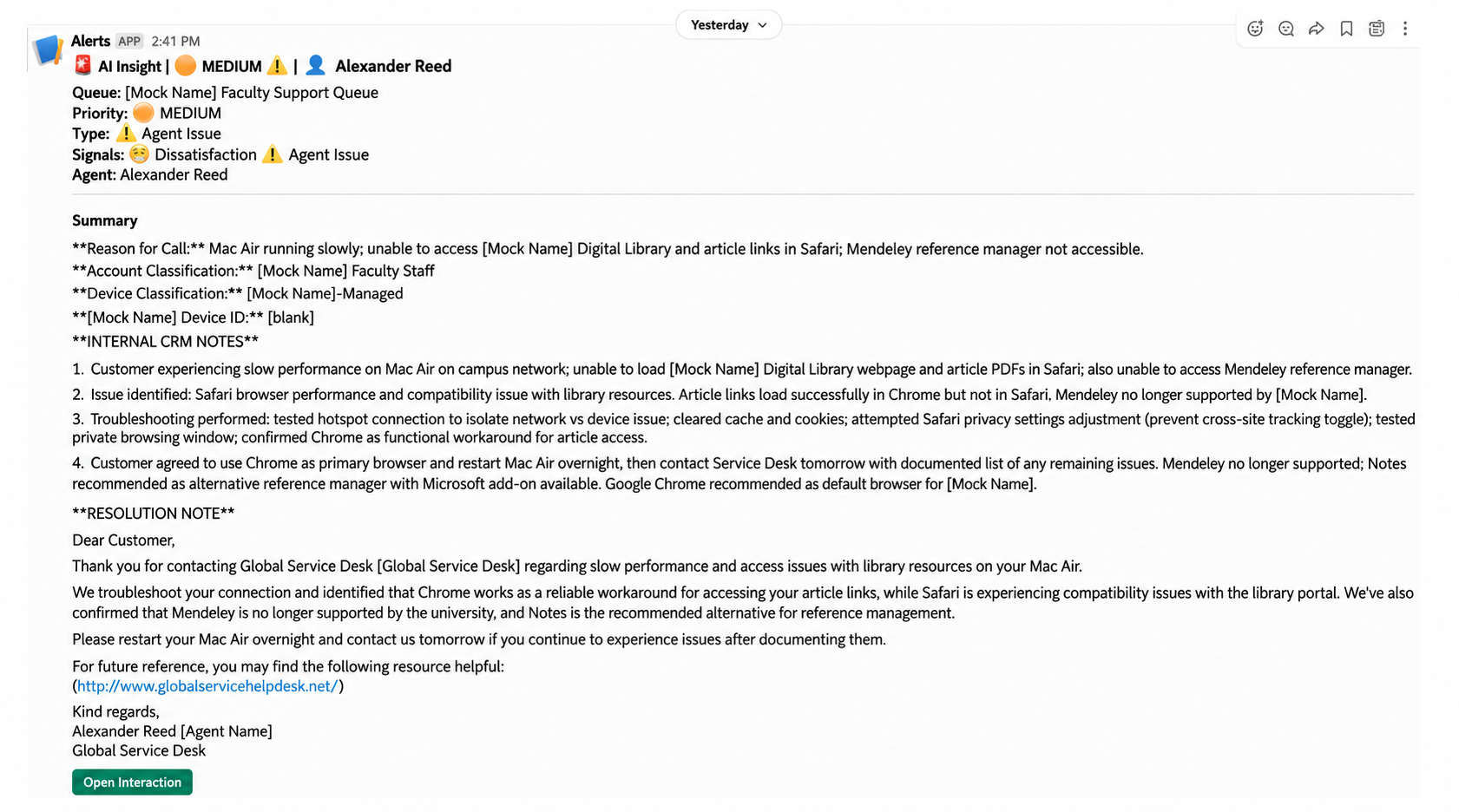
    For Password and MFA interactions, we structured the output as:

    Reason for Call → Account Classification → Internal CRM Notes → Resolution Note

    The instructions captured relevant account, device, software and queue-specific context. We included self-service URLs in the prompt, with rules determining which links belonged in the customer-facing resolution note.

    Internal notes documented four things: reason for contact, verification/recovery outcome or issue identified, actions performed, and outcome or pending next steps. For applicable video verification, they also recorded the identification document type without sensitive document details. Verification information and internal processes stayed out of customer-facing messages.

    Customer and agent first names personalised the greeting and signature when confidently identified. Otherwise, the greeting became "Dear Customer" and the agent name was left blank.

    Generate once, use many times.

    Agents could reuse the whole output or individual sections in tickets and customer emails. More consistent documentation also improved ticket quality for Tier 2 and specialist teams, who previously sometimes had to contact the original agent for missing context.

    We use the same structured Copilot summary for ticket documentation and customer-facing resolution messages. In Experiment 5, we also reuse it in post-interaction workflows triggered by relevant topic detections, sending the summary and interaction link to Slack for review. A sanitised example is shown there.

    We refined one base prompt, then adapted it for each queue. We tested the framework against more than 150 real interaction transcripts, checking accuracy, tone, classification, verification information, PII handling and edge cases.

    Early versions sometimes invented details or added advice that hadn't been discussed. We tightened the instructions to use only information evidenced in the transcript. Each queue-specific prompt also included a fallback for conversations outside that queue's usual purpose.

    I also shared our custom-summary framework and example prompt with the Genesys Community, so others could adapt the approach.

    🧪 Experiment 2 - Give Copilot our knowledge

    While investigating our longer-term knowledge architecture, we built an MVP using Google Apps Script to synchronise existing organisational knowledge into Genesys Knowledge, making it available through Copilot.

    Existing Knowledge → Google Apps Script → Genesys Knowledge → Agent Copilot

    🧪 Experiment 3 - From answering to guiding

    We introduced Agent Checklists to guide agents through process steps, adding support during the interaction alongside knowledge suggestions and summaries.

    🧪 Experiment 4 -  Give it something to do

    We used Copilot's NLU and rules engine to recognise identity verification intent and display the relevant agent script. Agents could then send Zoom verification information by email or SMS, remaining in control of the action.

    🧪 Experiment 5 -  Don't let the summary die when the interaction ends

    We reused structured summaries with topics and post-interaction workflows to surface knowledge gaps, customer complaints and potential ID&V compliance concerns.

    For relevant scenarios, the workflow retrieves the full Copilot summary through the Genesys Cloud API and posts it to the appropriate queue's Slack channel through an incoming webhook. The notification includes the full summary and a clickable interaction link, giving reviewers context for investigation.

    Example: Copilot summary and interaction link delivered to Slack for post-interaction review.
    🧪 Experiment 6 -  Bring the summary into the ticket workflow

    We integrated our CRM into the Genesys agent script, bringing ticket management into the agent's workflow.

    Agents review the Copilot output and manually copy internal notes and customer-facing resolution notes into the appropriate ticket fields, checking accuracy and making changes before saving or sending.

    Next in the laboratory: exploring automatic addition of internal notes to tickets and Copilot third-party actions that return information from external applications. Both remain future work.

    Our Copilot was evolving:

    Summarise → Inform → Guide → Act → Monitor

    ⚡ It's alive: Did anybody actually use it?
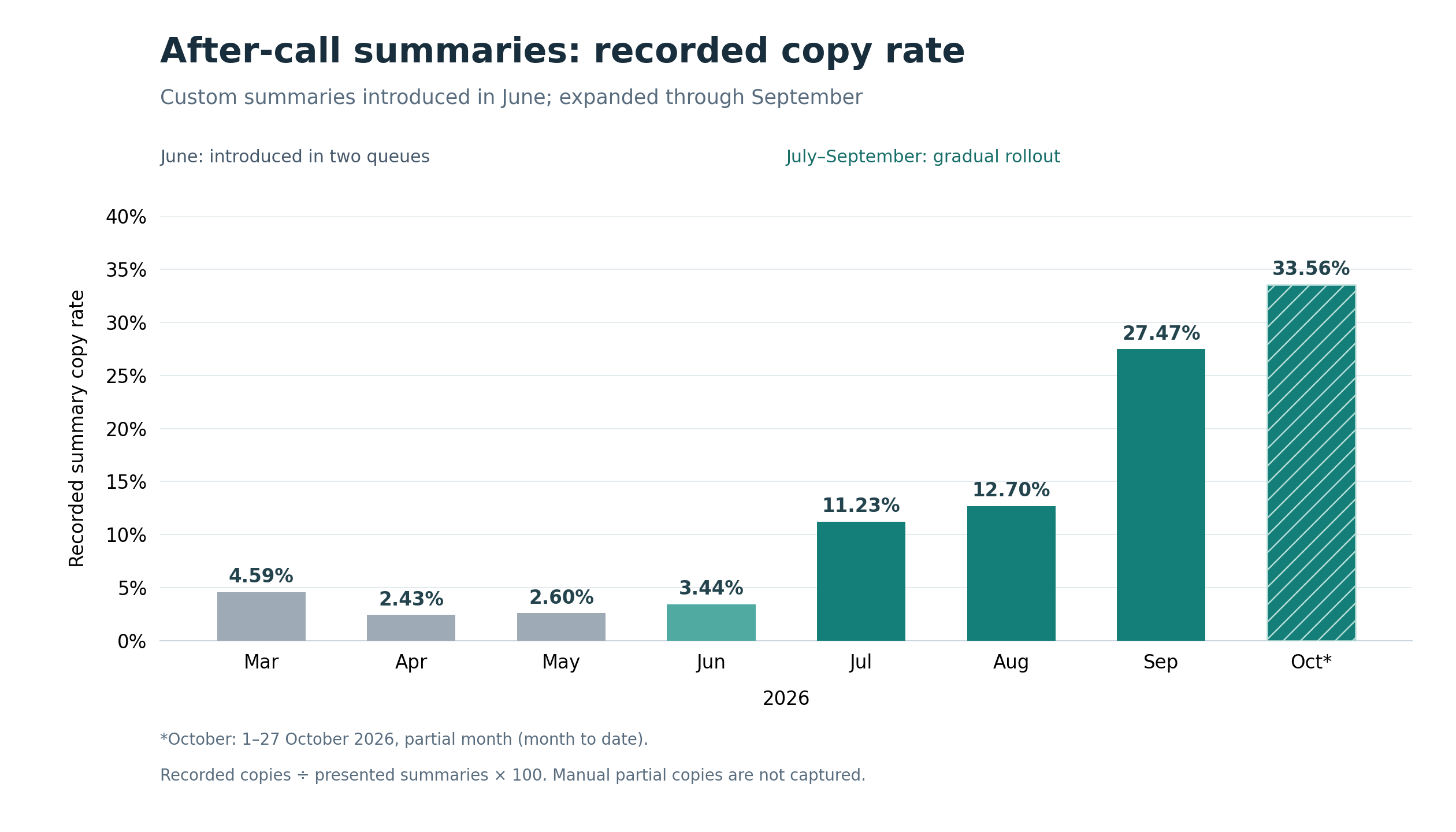
    We tracked the percentage of presented after-call summaries recorded as copied by agents: Copied ÷ Presented × 100.

    Month Recorded summary copy rate
    March 2026 4.59%
    April 2026 2.43%
    May 2026 2.60%
    June 2026- custom summaries introduced in two queues 3.44%
    July 2026 11.23%
    August 2026 12.70%
    September 2026 27.47%
    October 2026 - month to date, as at 27 October 33.56%


    Updated Copilot summary copy-rate bar chart

    Following the initial rollout and gradual expansion, the recorded copy rate rose from 2.60% in May to 27.47% in September, more than tenfold. In October, it reached 33.56% as at 27 October, showing continued reuse after the rollout. October figures cover a partial month.

    The experiment is still alive, and this graph isn’t finished. We’re confident there’s more value to unlock as we continue refining Copilot around our agents’ needs.

    Agents also manually reuse individual sections, such as internal CRM notes or customer-facing resolution notes, which we have observed in ticket documentation. These partial copies aren't captured in the Copied metric, so the figures do not represent all summary reuse.

    The result wasn't simply more configured AI features. Agents were increasingly taking Copilot's summaries into their after-call work.

    Making the output relevant to everyday tasks helped agents adopt AI through practical value. Increased recorded copying gave us a measurable sign of that reuse.

    🧠 Notes from the laboratory

    Enabling AI isn't the same as adopting AI.

    Our breakthrough was changing the question from "What can Copilot do?" to "What do our agents need Copilot to do?"

    We learned to build incrementally: refine summaries, measure reuse, add knowledge and guidance, introduce actions, and find further uses for the output.

    Measurement needed context. Comparing recorded copies with presented summaries helped account for changes in volume, while recognising that manual partial copying remained outside the metric.

    Our advice to another mad scientist:

    Don't make your agents adapt their workflow to AI. Start with the friction in their existing workflow and adapt the AI to help remove it.

    Our Copilot started as an underused conversation summariser. It's now becoming something that can summarise, inform, guide, act and monitor.

    ⚡ It's alive.


    ------------------------------
    Phaneendra
    Technical Solutions Consultant
    ------------------------------


  • 33.  RE: Bot Bash is BACK!

    Posted 15 days ago
    No replies, thread closed.


    ------------------------------
    James
    Senior Manage Solutions Architecture
    ------------------------------


  • 34.  RE: Bot Bash is BACK!

    Posted 14 days ago
    No replies, thread closed.

    Hi Nicole & Community Members,

    Although we have so "Gold Standard" templates to serve the need of our Clients, however every Client is different in many ways (region, language, work-ethics etc.) Some are more inclined on the Technical side, and most on Financial side of the Solution.
    Somewhere between this, the 'requirement Gathering' discussion become very vague. Especially since AI has come into teh picture, Customer are like - 'We need AI,' 'We need better CX,' 'AI in Omnichannel services,' 'more Intelligent Routing/Reporting' etc; But none of them are 'Requirements' they're just Objectives.

    As an Architect/Design Consultant we've identified flaws & missing information (for e.g. integrations, reporting expectations, even compliance issues surface late sometimes.) And at this time, we're not Designing anymore, We're just chasing information !

    THE GROTESQUE

    We mostly realise during the Customer Workshops, that the issue is not with teh Workshops but events that took place before that - 
    Customer emails, sales discussions, proposals, meeting notes, RFP responses & internal conversations all contained pieces of the puzzle, but hardly anyone took the time to connect them.

    The result was usually the same - Missing requirements, Unanswered questions, risks, Assumptions presented as facts, unaccountability.

    (1st part of image below captures exactly what that looks like.)

    THE EXPERIMENT

    To address this, I created what I call a Discovery Framework Assistant, with an objective of having better discussion during Workshops; as the details would've been already reviewed/validated by teh 'Assistant.''

    Information like -
    Proposal documents, RFP responses, Sales notes, Customer emails, Discovery meeting transcripts, Previous workshop outputs

    It then organises information into practical design areas like -
    Customer Experience, Routing, Reporting, Workforce Engagement, Integrations, AI

    More importantly, it highlights what's missing, for e.g.

    1. If a customer says: We need call recording. The assistant asks: 
    All calls or selected calls?, Retention period?, Compliance requirements?, PCI considerations?

    2. If a customer asks for Ai enabled Intelligent routing. The assistant asks:

    Skill-based?, Language-based?, VIP handling?, Predictive Routing?

    Rather than providing answers, it identifies the questions that still need answering.

    (2nd part of image below captures exactly what that looks like)

    IT'S ALIVE

    So, since we've started using the Assistant, our Workshops starts with -
    "Here's what we've understood so far, here are the assumptions we've identified, and here are the topics that still need clarification."

    Instead of "Tell us what you need."

    We're having more focussed conversations relating to - bespoke requirements, risks & compliance, identifying other gaps (especially for so-called 'like-to-like migrations.' No more chasing information.

    (3rdpart of image below captures exactly what that looks like)

    1. THE GROTESQUE, 2. THE EXPERIMENT, 3. IT'S ALIVE


    thanks


    ------------------------------
    Ashiesh Sharma
    GCX- GCP, ARC, SCR, QM
    Producer | Conductor | Composer
    BT plc
    ------------------------------


  • 35.  RE: Bot Bash is BACK!

    Posted 13 days ago
    No replies, thread closed.
    1. What needed a few stitches?

    Our IVR was designed to collect the customer's first name and use it later in the interaction. However, the speech recognition engine frequently failed to recognize customer names correctly, especially when names had different pronunciations, accents, or background noise. This resulted in poor customer experiences, repeated prompts, and incorrect customer information being captured.

    To solve this, we initially moved from a traditional IVR name-capture process to Genesys Virtual Agent AI capabilities and implemented AI-powered slots for collecting customer names. While this improved accuracy, some customer names were still not recognized correctly.

    2. What did you change?

    Migrated name collection to Genesys Virtual Agent AI

    • Replaced the standard IVR speech recognition process.
    • Configured AI-powered slots specifically for capturing customer first names.

    Analyzed recognition failures

    • Reviewed interaction logs and customer feedback.
    • Identified that uncommon names and pronunciation variations were still causing recognition issues.

    Implemented Spell-Out Name functionality

    • Added a fallback option that allows customers to spell their names letter by letter when AI recognition confidence is low.
    • Enhanced the bot flow to intelligently switch to the spell-out experience when needed.
    • Validated and stored the spelled name before continuing the interaction.What happened 
    What happened next?
    • ✅ Improved customer name capture accuracy
    • ✅ Reduced customer frustration and repeat prompts
    • ✅ Increased confidence in customer identification
    • ✅ Better overall self-service experience
    • ✅ Reduced need for agent intervention due to incorrect name collection

    Lessons Learned

    • AI-powered slots greatly improve name recognition, but edge cases still exist.
    • Having a fallback mechanism is critical for capturing information accurately.
    • Combining Genesys Virtual Agent AI with a Spell-Out Name strategy creates a much more reliable customer experience.
    • Continuous testing with real customer names helps identify scenarios that require additional tuning.


    ------------------------------
    Anand
    Skylux Telelink Pvt Ltd - India
    GCP,GCD, ARC,SCR,OD,
    ------------------------------


  • 36.  RE: Bot Bash is BACK!

    Posted 13 days ago
    No replies, thread closed.

    THE GROTESQUE: What needed a few stitches?

    Our helpdesk agents are required to identify the employee before they're able to help them. This typically involves sending them a text message through Genesys on behalf of an outbound queue. This process is tedious and repetitive, so we wanted to find a way to automate it and make it better. 

    THE EXPERIMENT: What did you change?

    I wanted to experiment with this as our first use case for agentic agents because we have a good use case here to introduce a level of intelligence into the process.

    I built an agent that will look at your phone number and look you up in Okta, our identity provider, because that's where your phone number on file lives.

    • If you have a phone number on file, it sends you an Okta push notification. If you can't get an Okta push notification because maybe you got a new phone and we have to reset your MFA, it'll fall back to sending you a text message.
    • Additionally if you call from Genesys internally to our help desk, it will know that as well and be able to identify you that way and follow the same process. 
    • This test resulted in the creation of seven tools that the agent can use, along with a robust set of guardrails and guidelines
      image
      image
      image

    IT'S ALIVE: What happened next?
    Overall, this has worked really well and it can reliably do identity verification for our employees. It's going to go out in production soon.

    • I learned that it's best to not overcomplicate the guidelines and instructions for the agent and to try to reduce the complexity where it makes sense.
    • I also learned that you can develop these completely using the Genesys AVA harness. I barely touched any of the configurations for this and just did a lot of iterations with Claude because part of my experiment is that I wanted to try to leverage AI completely to see what it could do.
    • The preview utility is very powerful and using digital chat over voice allows you to rapidly test things. You can do some of the fine-tuning over voice. Depending on your use case. This is going to be used in a voice IVR.
    • The next phase of this project is going to be to allow password resets and MFA resets by the agent, eventually letting it become a self-service helpdesk agent but our initial use case was identity verification 

    In summary, find a cool use case for an agentic agent and have fun. I highly recommend using the AVA harness to develop it because it just makes it so much easier. In my experience Claude using the harness can really understand how these need to be created and will save you from a lot of headaches. 

    Genesys AVA Harness: https://github.com/purecloudlabs/genesys-ava-skills


    ------------------------------
    Caleb Smith
    IGS Energy
    ------------------------------


  • 37.  RE: Bot Bash is BACK!

    Posted 12 days ago
    No replies, thread closed.

    Bringing a 20-Year-Old Journey Back to Life

    THE GROTESQUE: Our IVR came back from another era

    As part of a move from a legacy contact-centre platform to Genesys Cloud, we had a self-service IVR whose routing approach had evolved from a design adopted around 20 years ago.

    The old model relied on predetermined IVR exit points mapped to numerous routing points and parameters. It worked, but recreating the same approach in the cloud would have made it difficult to maintain and extend as new self-service journeys were introduced.

    We didn't want to simply rebuild the old monster on a new platform.

    THE EXPERIMENT: Make the conversation drive the routing

    The journey was redesigned around Genesys Cloud plus conversational AI self-service.

    Genesys Cloud orchestrates the Genesys side of the journey, passing the required context into conversational self-service. When self-service finishes, the call returns to Genesys together with information collected during the conversation.

    The initial journeys cover parcel tracking and redelivery, including the capture of tracking references, addresses and names. A caller can also move between journeys, for example from tracking into redelivery, without starting again.

    Here's the part I found most interesting.

    Instead of recreating a large number of predetermined IVR exits, downstream routing can use the intent and context returned from the conversation.

    The returned intent can even be different from the starting intent if the customer's need changes during self-service.

    Conceptually:

    Call → Genesys → Conversational Self-Service → Intent + Context → Genesys → Right Next Journey

     IT'S ALIVE!

    The legacy self-service capability has now been replaced as part of the Genesys Cloud transformation with a new conversational self-service capability.

    But the real win wasn't simply replacing old technology.

    The customer's conversation can now influence what happens next.

    Intent and collected context can drive more precise downstream routing while allowing additional self-service journeys to be introduced over time.

    There's also a neat shortcut for some mobile callers: the journey can identify recent parcel notifications and allow the caller to confirm the relevant parcel instead of speaking and confirming the entire tracking reference.

    WHAT I LEARNED

    My biggest takeaway:

    Cloud migration shouldn't mean rebuilding yesterday's IVR on tomorrow's platform. When replacing a legacy IVR, question the assumptions hidden inside the old routing rather than simply reproducing them.

    Sometimes the best thing to bring back to life isn't the old flow. It's the customer journey the old flow was trying to create.


    ------------------------------
    Akhil
    ------------------------------


  • 38.  RE: Bot Bash is BACK!

    Posted 12 days ago
    No replies, thread closed.

    One of the projects I worked on involved improving a bot workflow in Genesys Cloud, leveraging AI to enhance the customer experience.

    I identified opportunities to make the digital journey more intuitive, improve the interpretation of user requests, and route customers more accurately, thereby reducing friction during the service interaction.

    Following this, I focused on optimizing the workflow by refining decision rules, reduce the token utilization and validating various interaction scenarios. The goal was to create a more seamless experience, minimize customer effort, and contribute to better satisfaction metrics-most notably the Net Promoter Score (NPS).

    This project reinforced my belief that automation should go beyond mere operational efficiency: it must simplify the customer's experience while creating value for the business.


    ------------------------------
    Christian Kato
    Coddera Software Ltda
    ------------------------------


  • 39.  RE: Bot Bash is BACK!

    Posted 11 days ago
    Edited by Dominik Buehler 11 days ago
    No replies, thread closed.

    🧟 From Frankenflow to an AI-Powered Blueprint

    🧟 THE GROTESQUE: What needed a few stitches?

    It started with a monster.

    For a large Genesys Cloud deployment across many business units, we use a reusable blueprint: one large inbound flow, one In-Queue Flow and several Common Modules, with the business-specific routing controlled dynamically through Genesys Cloud Data Tables.

    The approach keeps deployments consistent and fast-but after many go-lives, the routing configuration itself becomes a creature of its own.

    Hundreds of numbers, menu choices, queues and routing relationships live across the Data Tables.

    Then somebody asks:

    "Which numbers can actually route to Queue X?"

    Or:

    "If I change this menu entry, what existing routing could I break?"

    Answering that manually means tracing flows, Common Modules and Data Tables, followed by DNIS-by-DNIS and menu-by-menu regression testing.

    Our monster needed a brain. 🧠

    🧪 THE EXPERIMENT: Giving the Blueprint a Brain

    The core of the experiment is simple: export the relevant Data Tables into one Excel workbook and let ChatGPT or Claude understand the blueprint logic.

    Once the AI knows how the routing model works, we can ask questions such as:

    "Which numbers route to Queue X?"

    "Find routing paths that end in a dead end."

    "I changed this menu entry. Which existing scenarios are affected?"

    The AI follows the relationships between DNIS, menu choices, Data Table entries and destinations and produces a structured report within seconds.
    Below you can see a detailed report on the question "Which numbers route to BBS_Sales Queues?"

    This turns a large routing configuration into something that is not only easier to understand, but also much easier to regression-test after every rollout or configuration change.

    At the same time, we are gradually making the blueprint itself more intelligent.

    Instead of modelling every customer choice as a traditional IVR menu and storing every branch in Data Tables, we also have the opportunity to tie in Genesys Virtual Agent and AVA as endpoints within the blueprint. AI-powered slots and natural-language understanding can capture what the customer actually wants and hand the result back into the same reusable routing framework.

    That reduces the amount of menu logic we need to maintain and keeps the Data Tables smaller.

    ⚡ IT'S ALIVE: What happened next?

    After many business-unit go-lives, the blueprint kept growing - but it became much easier to control.

    Instead of manually navigating through a huge flow and multiple Data Tables, we can now ask the configuration questions in natural language and get the answer in seconds. Also helps a lot with getting an accurate documentation in place fast.

    More importantly, every change can be checked against the existing routing logic before deployment.

    The result is a blueprint that combines:

    • AI-powered analysis and regression testing for the routing configuration

    • Genesys Virtual Agent and AVA to replace traditional menu logic with AI-driven conversations

    Architect remains the engine.
    Data Tables remain the configuration.
    Genesys AI handles more of the conversation.
    And AI helps us understand whether the monster is still behaving as expected.

    It's AI-live. ⚡🧟


    ------------------------------
    Dominik
    Principal Professional Services Consultant
    ------------------------------


  • 40.  RE: Bot Bash is BACK!

    Posted 11 days ago
    No replies, thread closed.

    Beyond Handling Time: Rethinking Call Routing with Genesys AI

    THE GROTESQUE – What needed a few stitches?

    In our operation, call routing currently follows a rule that prioritizes agents with lower Average Handling Time (AHT).

    At first glance, this seems like a straightforward way to improve efficiency. However, it raises an important question: What if the fastest agent isn't always the best agent for the customer?

    In customer service, speed is important, but it is not everything. A shorter interaction does not necessarily mean a better resolution or a more positive customer experience.

    This made us question whether our current routing approach gives enough attention to other important aspects of service quality.

    We realized there was an opportunity to rethink how calls are distributed, looking beyond handling time alone.

    THE EXPERIMENT – What did you change?

    Our proposed experiment is to explore Genesys Predictive Routing as a way to evolve our current routing strategy.

    Instead of focusing mainly on agents with lower AHT, we want to investigate how AI-powered routing could help balance operational efficiency with customer experience.

    Some of the business outcomes we would like to explore include:

    • Average Handling Time (AHT).

    • Service quality and monitoring scores.

    • Customer satisfaction (CSAT).

    • First Contact Resolution (FCR).

    The idea is to understand how predictive capabilities could help identify the most suitable agent for each interaction, based on the business outcomes that matter most.

    This is a proposed initiative, not an implemented solution. We have not yet activated Predictive Routing in our operation. Our goal is to investigate its capabilities, understand its requirements, and evaluate how it could fit our environment.

    IT'S ALIVE – What happened next?

    Although the experiment has not yet been implemented, it has already challenged the way we think about operational performance.

    Our expected outcome is to reduce handling time without sacrificing service quality.

    We also hope to better understand how AI can support smarter routing decisions, helping organizations move beyond traditional performance indicators.

    Our biggest takeaway so far is simple:

    Efficiency should not be measured by speed alone. The real goal is to deliver the right experience while making the operation more efficient.

    If there is one thing we would tell another team exploring AI-powered routing, it is this: start by questioning what your current metrics are really telling you. Sometimes, the biggest opportunity for innovation begins with a simple question.


    ------------------------------
    ------------------------------
    Thais Araújo.
    Contact Center Supervisor
    Grupo Equatorial Energia | Brazil
    ------------------------------
    ------------------------------


  • 41.  RE: Bot Bash is BACK!

    Posted 9 days ago
    No replies, thread closed.

    Thank you everyone for your entries into this year's Bot Bash--our biggest year yet with some absolutely incredible innovations! Entries are now closed and judging will begin soon. Keep an eye out for winner announcements soon!


    ------------------------------
    Ami
    Senior Manager, Online Communities
    ------------------------------


  • 42.  RE: Bot Bash is BACK!

    Posted yesterday
    No replies, thread closed.

    The winner of the 2026 Bot Bash is...click here to find out! 


    ------------------------------
    Nicole
    Senior Online Community Video Specialist
    ------------------------------