When/what/why is "May Day"?
The 1st of May is known as "May Day" and traditionally involves dancing around a May Pole, crowning a May Queen, Morris Dancing and generally celebrating the oncoming summer.
Celebrations and customs differ from country to culture, but the gist of the celebration is the same throughout.
What are May Day traditions?
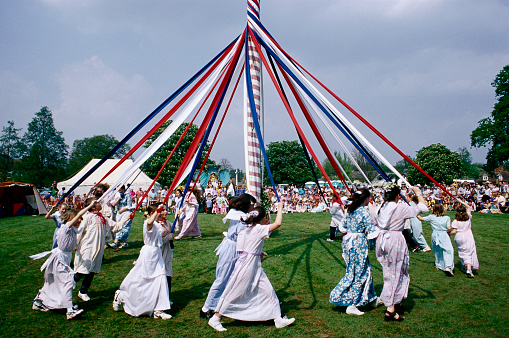
The tradition of "dancing around the Maypole" is steeped in history and is celebrated by various cultures around the world.
England
Traditionally, a young tree would be felled and set up to dance around in celebration of the oncoming summer.
Ribbons and flower garlands would add to a colourful display, fitting to a bright spring day of celebration.
Scotland and Ireland
Back in the Middle Ages the Gaelic people of Scotland and Ireland celebrated the festival of "Beltane".
Beltane means "Day of Fire". They built large bonfires and danced at night to celebrate – a tradition that many are revisiting now.
Wales
In Wales May Day is also known as Calan Mai or Calan Haf. May 1st was an important time for celebration and festivities in Wales as it was considered to be the start of summer.
Marking neither an equinox nor a solstice, May Day referred to the point in the year when herds would be turned out to pasture.
In the time of the Druids, fires for the Baltan (see Beltane, above!), represented an opportunity for purification, and to protect animals from disease.
These fire-lighting ceremonies were carried out with a great deal of pomp and ceremony!
Other countries
Walpurgis Night – Some countries celebrate the night before May Day called "Walpurgis Night".
These countries include Germany, Sweden, Finland, and the Czech Republic.
The celebration is named after the English missionary Saint Walpurga.
Again, people celebrate with large bonfires and dancing.
Dancing around the Maypole – what's that all about?
So, most countries/cultures celebrate May Day with bonfires and dancing, so where does Maypole Dancing come into it?
A maypole is a wooden pole, about 3-5 metres tall, set up as a part of a variety of European folk festivals, around which a "maypole dance" often takes place.
In simple terms, the ribbons descending from the top of the Maypole will criss-cross as everyone dances, until each participant is united with their ideal partner!
How come we get a Bank Holiday for May Day? (For some of us!)
In 1890 the May Bank Holiday became associated with International Workers' Day as the Second International organised a day of protests in support of an eight-hour working day.
After that the 1st May was linked with protests and became an official holiday in 1978.
In America, May 1st is known to this day as "Labor Day". Canada celebrates it's equivalent on the first Monday in September.
So there's some history about May Day and although we're still waiting for Spring to arrive here in the UK (currently 12° C/53.6° F and raining!) - we would be interested to know, what is your favorite Public Holiday where you are from and how do you celebrate it?
#Genesys Cloud CX
#Workforce Engagement Management
------------------------------
Tracy
Genesys
------------------------------