Original Message:
Sent: 06-23-2026 07:57
From: Roman Vondracek
Subject: AVA - Ending the call
Is there any clear guidance on this?
I'm testing AVA and having trouble getting it to properly end the session.
Honestly, this feels like it should be a very basic capability - if I say "terminate", it should terminate, not require trial-and-error with multiple prompt variants.
What am I missing here?
------------------------------
Roman Vondracek
Technical Architect
------------------------------
Original Message:
Sent: 05-27-2026 19:29
From: Will Bellerby
Subject: AVA - Ending the call
Thanks for that, using Architect makes sense.
I've made these changes and still have to give the "OK" for it to end the AVA session. Seems like a bug honestly! I get it that AVA's are agentic, but these things need to work in a predictable, repeatable way. With this customer, our POC has essentially failed on this and we won't be going live - they're looking at other vendors.
------------------------------
Will Bellerby
CX Consultant
------------------------------
Original Message:
Sent: 05-27-2026 17:09
From: Gabriel Garcia
Subject: AVA - Ending the call
Will,
I believe the behavior you are seeing is actually consistent with how AVA session termination currently works.
One important detail from the documentation:
the Exit Response is treated more like a conversational recommendation than a deterministic disconnect command. AVA may still wait for voice completion/silence detection before the session lifecycle fully closes.
In practice, we had better results by:
- keeping the final response extremely short
- removing conversational closing language
- and in some cases leaving the AVA Exit Response empty entirely and handling the final message directly in Architect
For example:
AVA:
(no Exit Response configured)
Architect:
Play Audio / Communicate
→ "Your service request has been submitted."
→ immediate disconnect/flow exit
That approach gave us much more predictable behavior in voice scenarios because Architect controls the actual termination state more deterministically than the conversational layer itself.
We also noticed phrases like:
"Goodbye"
"Have a great day"
or future-oriented wording
sometimes encourage the model/runtime to maintain the conversational turn slightly longer.
So for production voice flows, the cleanest pattern we found was:
AVA completes task
→ return control to Architect
→ Architect delivers final prompt
→ immediate disconnect
That usually avoids the extra wait-state much more consistently.
------------------------------
Gabriel Garcia
NA
------------------------------
Original Message:
Sent: 05-27-2026 16:37
From: Will Bellerby
Subject: AVA - Ending the call
Thanks for that Gabriel,
I've copied what you provided, and it's still pausing to wait for a response.
"If the service request is successful:
Inform the caller: "Your service request has been submitted."
End the session immediately after delivering this message."
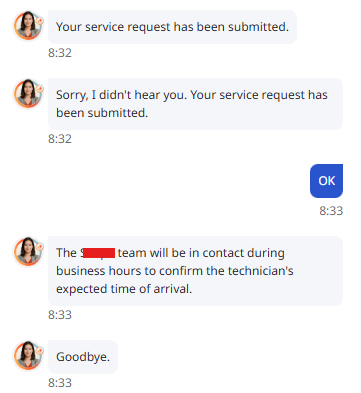
My Exit Response is this: The [customer] team will be in contact during business hours to confirm the technician's expected time of arrival. Goodbye.
------------------------------
Will Bellerby
CX Consultant
Original Message:
Sent: 05-20-2026 22:18
From: Gabriel Garcia
Subject: AVA - Ending the call
This is expected AVA behavior in many cases.
The model interprets "inform the caller" as a conversational turn, so it waits for confirmation before the session lifecycle closes.
What worked for me was making the instruction operational instead of conversational.
Try something closer to:
"If the service request is successful:
Inform the caller: 'Your service request has been submitted.'
Do not ask any follow-up questions.
Do not wait for user confirmation or acknowledgement.
Immediately terminate the session after sending the message."
Also make sure your Exit Response is configured independently, because AVA will often treat the final agent utterance and session termination as separate actions.
One important detail:
Avoid phrases like:
Those often trigger another conversational turn internally.
The cleanest production pattern I've found is:
Final fulfillment message
Immediate session termination instruction
Minimal/no conversational language
Example:
"Your service request has been submitted. End the session immediately after delivering this message."
That usually prevents the extra wait-state.
------------------------------
Gabriel Garcia
NA